A dynamic badge system that lifted CTR +10% and conversion +5% on Claro's Accessories PLP
Scaling a proven card model across a new product line — and turning static product cards into high-signal, rule-driven merchandising units that update themselves.
Outcomes
Result: +10% CTR and +5% conversion on the Accessories PLP, +20% interaction with badge-related filters, and <1% visual/catalog bug rate.
My role: Led UX/UI end-to-end — designed the cards on Claro's Mondrian 6 design system and defined a dynamic badge architecture tied to catalog and campaign rules.
Business impact: Unified the Devices and Accessories experience and shipped a self-updating merchandising system reused across squads — cutting design and dev effort for future campaigns.
TL;DR
Business goal: Improve visibility and performance of accessories through better cards, campaigns and merchandising tools.
What I did: Scaled a proven card model from Devices to Accessories, introducing a dynamic badge system tied to catalog rules.
Outcome: +10% CTR, +5% conversion, +20% badge-filter interaction, <1% bug rate.
Context & Business Goal
Claro’s e-commerce had recently introduced a new card model for the Devices PLP, which showed strong performance improvements. However, the Accessories PLP was still using an older layout with limited support for:
Campaign visibility
Strategic product highlighting
Consistent brand and UX patterns
Business goal: Align the Accessories PLP with the new card model and unlock better merchandising performance through dynamic badges and stronger visual hierarchy.
The Challenge
The existing Accessories PLP suffered from:
Outdated card layout misaligned with the new Devices PLP
No effective way to highlight offers, launches, or low-stock products
Weak support for commercial and marketing strategies
This resulted in:
Friction in cross-category navigation (Devices vs Accessories)
Lower discoverability of strategic items
Missed opportunities to leverage campaign, stock, and pricing data
Key Constraints
Strict adherence to Claro’s Mondrian 6 design system for components
Compatibility with existing catalog and campaign systems
Need to avoid performance regressions on both desktop and mobile
Shared ownership across multiple squads and platforms
Personas
Cold Audience (The Retail-Driven Shopper)
Users coming from Online Media and Google / CPC channels.
Their journey is primarily driven toward Acquisition and Number Portability. They show low trust and high sensitivity to price and fraud, often comparing the experience to major Brazilian retailers such as Magalu and Casas Bahia.
Warm Audience (The Loyal Customer)
Users arriving through the Minha Claro app and Direct Marketing (Existing Base) channels.
Their main journeys focus on Device Purchase and Plan Migration. They have high trust, prioritize benefits, and value an ongoing relationship with the brand. These users expect VIP treatment and personalized recognition.
My Role
I led the UX/UI design for this initiative, responsible for:
UX audit of the current Accessories PLP
Design of new product cards using Mondrian 6
Definition of a dynamic badge architecture driven by catalog/business rules
Integration of badges with filters and commercial strategies
Alignment with design system and engineering teams
Participation in KPI definition and validation post-launch
Discovery & Benchmarking
Together with Product and Analytics, I first built a clear picture of the current state:
How accessories were performing vs devices
Which attributes were most important for purchase decisions
How users visually scanned and interpreted the PLP
Key activities:
UX audit of the existing Accessories PLP (structure, visual hierarchy, responsiveness)
Analysis of campaign and category performance data
Mapping all existing business flags and catalog rules (e.g. new, offer, launch, last units)
Alignment with design system and front-end teams on feasible patterns
This groundwork allowed us to define:
Which badges mattered most for both users and commercial teams
Where badges should live within the card
How the model would scale across breakpoints and categories
Solution Overview
1. Mondrian 6 Product Cards
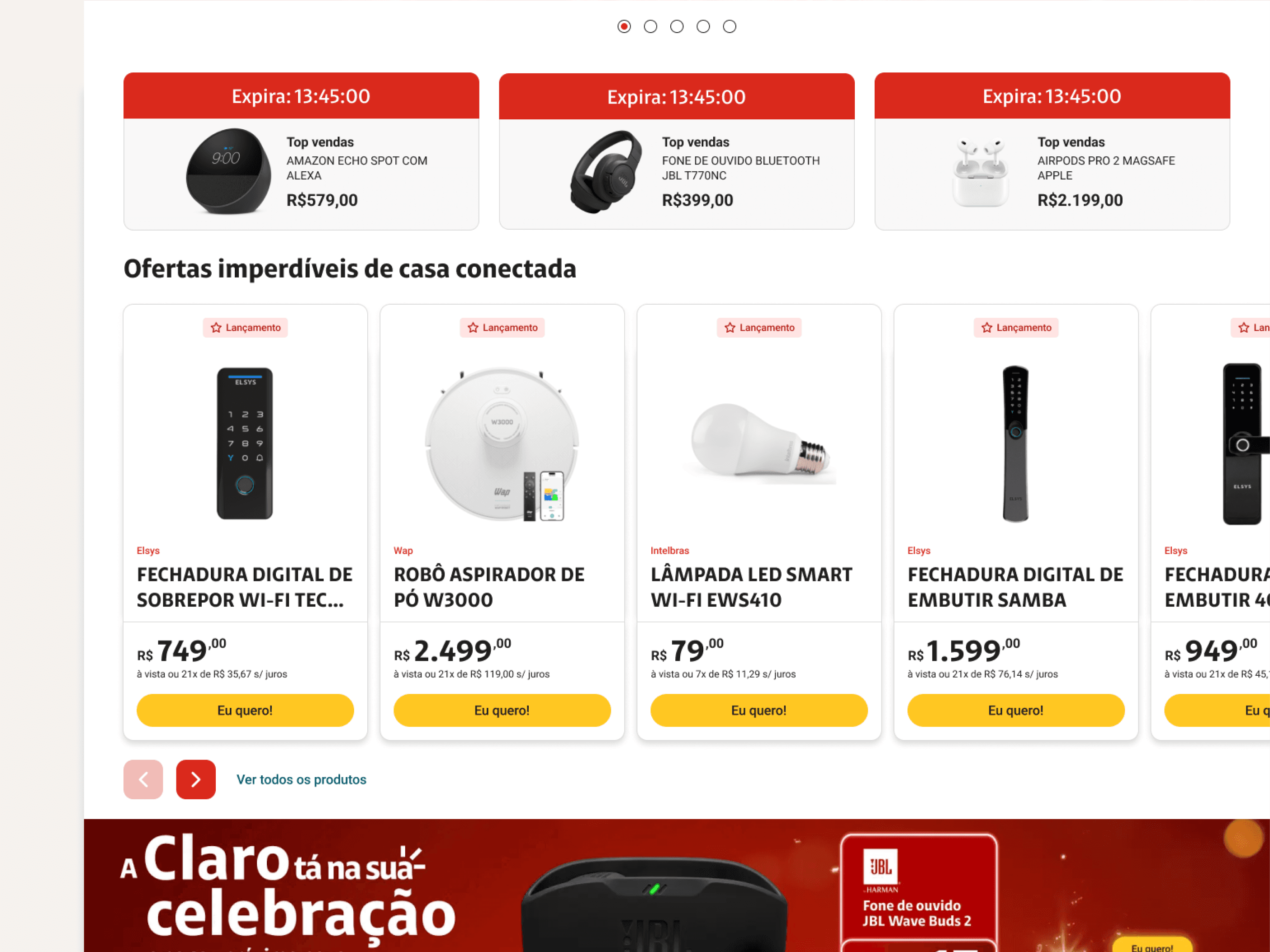
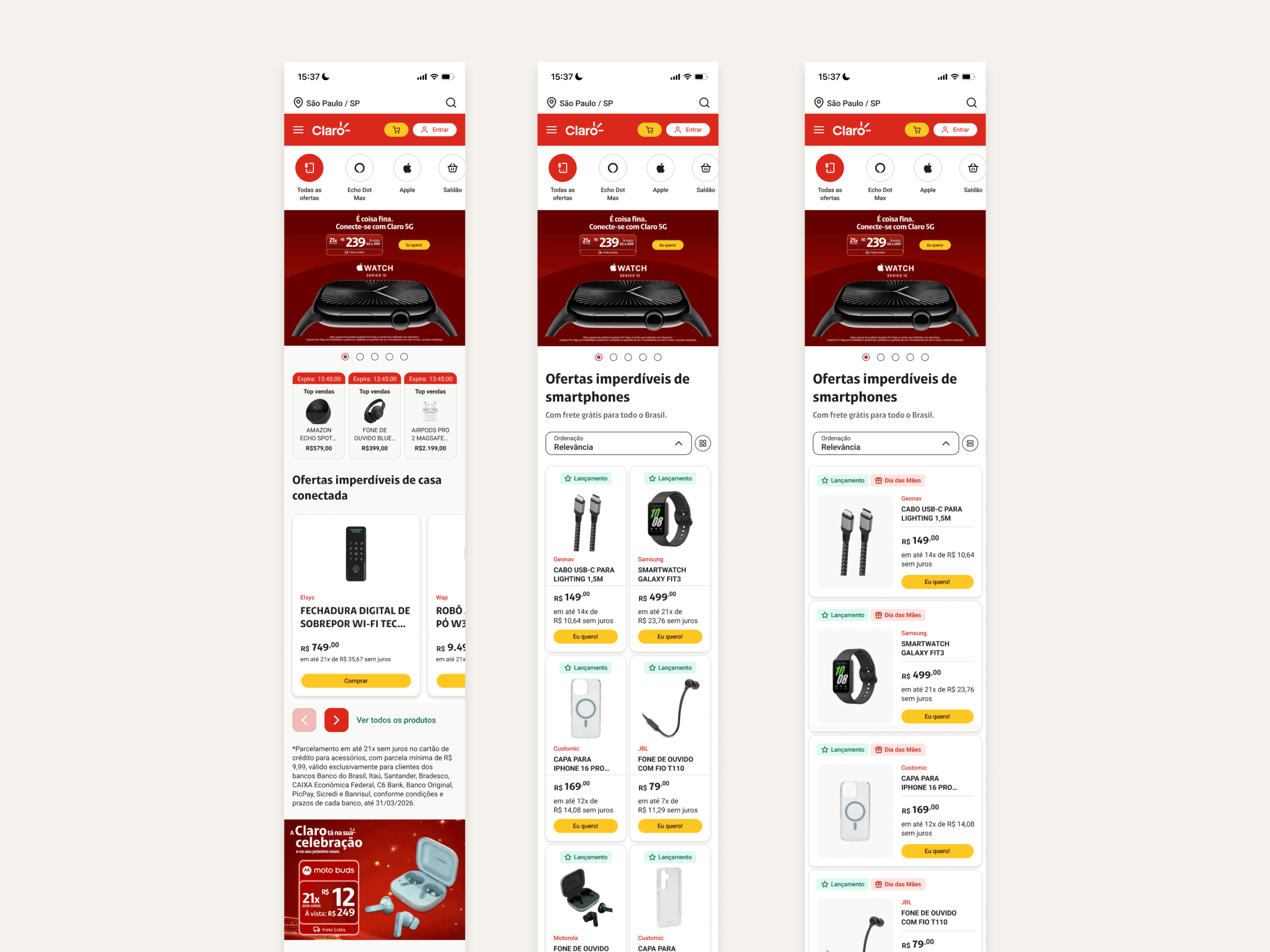
We redesigned the Accessories cards using Mondrian 6, Claro’s internal design system:
Clear visual hierarchy between image, title, price, and actions
Improved spacing and scannability for dense catalogs
Strong affordances for campaign states and product status
Fully responsive behavior across desktop and mobile
Reuse of core design system components for consistency and maintainability
2. Dynamic Badge System
We introduced a dynamic badge architecture to highlight:
New
Launch
Last units
Offer
Key characteristics:
Badges driven entirely by existing catalog and campaign rules
Real-time updates with no manual intervention
Centralized logic to ensure consistency across squads and surfaces
Space and priority rules to avoid badge overcrowding
Badges turned product cards into high-signal units, helping users quickly understand:
What’s new
What’s on offer
What’s scarce
3. Integration with Commercial Filters
To connect visual storytelling with interaction, we:
Integrated badges with the commercial filter system
Allowed users to filter by campaigns or product status
Enabled faster discovery of offers and strategic items
This shifted the PLP from being “just a list” to a performance surface that supports both user goals and commercial strategy.
Design Process
Design Exploration
I explored:
Card anatomy variations and content density
Badge hierarchy and placement (what shows first, what coexists)
Contrast and accessibility for badge states
Mobile-first layouts and tap targets
Edge cases (multiple badges, long titles, complex pricing)
Deliverables included:
Component specs and variants
Responsive behavior definitions
Documentation of states (default, promo, low-stock, etc.)
Token usage aligned to Mondrian 6
Design System Alignment
I worked closely with the design system team to ensure:
Full component compliance with Mondrian 6
Reusable badge logic that could extend beyond accessories
Scalable documentation for future squads and surfaces
Patterns that could support new campaign types without redesigning cards
Stakeholder & C-Level Alignment
I presented the solution to:
Product leadership
E-commerce & Commercial stakeholders
UX leadership
The narrative focused on:
Business impact: CTR, conversion, campaign visibility
Design system scalability and long-term efficiency
The PLP as a performance and storytelling surface
This alignment secured prioritization and clarity around KPIs for post-release evaluation.
Collaboration with Engineering
Working closely with front-end and back-end teams, we:
Ran feasibility workshops to map catalog rules to UI behaviors
Defined badge logic, priorities, and fallbacks (e.g. what happens if multiple rules apply)
Documented responsive behaviors and breakpoints
Collaborated on implementation details to minimize regressions
This co-creation approach reduced rework and improved delivery speed and quality.
QA, Validation & Post-Launch Iteration
Post-development, I led design validation for:
All major breakpoints
Different campaign types and rule combinations
Catalog edge cases (missing data, long names, etc.)
Performance and loading states
We performed:
Design QA sessions
Visual regression checks
Catalog consistency testing
This led to targeted micro-optimizations:
Badge contrast tuning
Card density and spacing adjustments
Touch-target refinements for mobile
Overflow and truncation rules for titles and labels
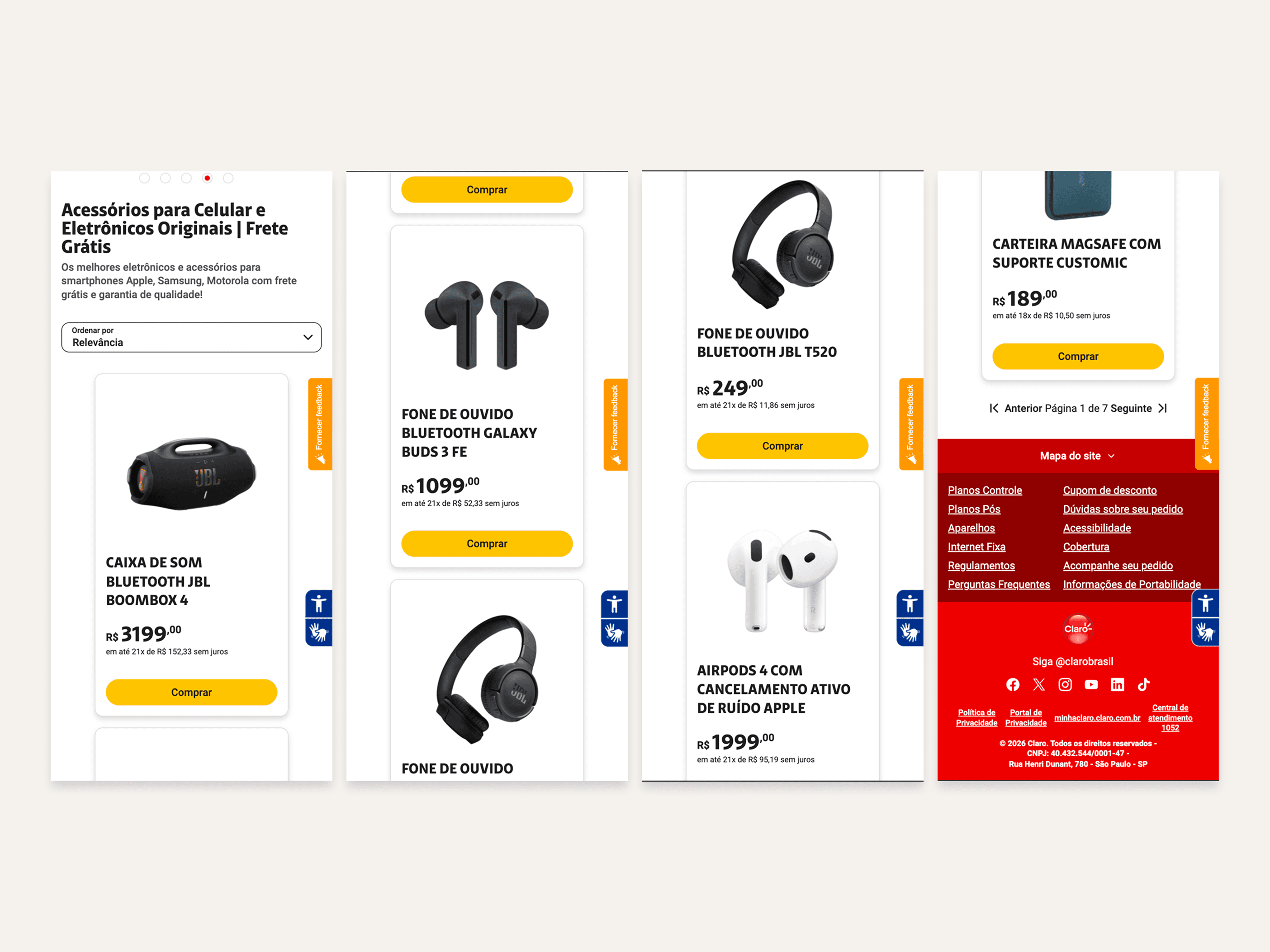
Images: before and after redesign:


Results & Impact
After launch, we tracked the impact via Analytics and internal dashboards:
+10% CTR on accessory product cards
+5% conversion rate on the Accessories PLP
+20% interaction with badge-related filters
<1% bug rate related to visual or catalog issues
Beyond metrics, the project:
Unified the experience and visual language across Devices and Accessories PLPs
Increased campaign and commercial visibility
Strengthened design system adoption (Mondrian 6)
Reduced design and development effort for future PLP and campaign initiatives
Key Learnings
Design systems become much more powerful when combined with rich business logic.
PLPs are not just browsing surfaces, but commercial storytelling tools.
Early alignment with engineering and commercial teams dramatically improves quality and speed.
Visual hierarchy has a direct impact on perceived product value and engagement.